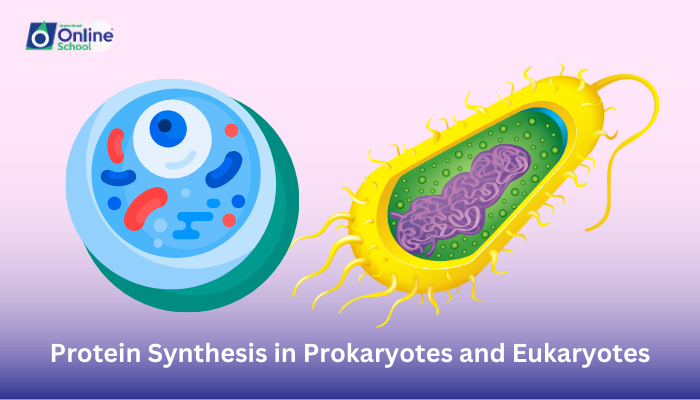
Learning Outcomes:
i. Identify the key differences in protein synthesis between prokaryotes and eukaryotes.
ii. Understand the impact of these differences on cellular complexity and function.
iii. Appreciate the diversity and adaptability of life at the cellular level.
Introduction:
Imagine you and your friend are tasked with baking a cake. You both have the recipe (DNA), but your kitchens (cells) are vastly different! This lesson delves into the intriguing world of protein synthesis, where the recipe plays out differently in prokaryotic and eukaryotic cells. Buckle up, because it's about to get interesting!
i. The Stage is Set:
Prokaryotes: Picture a simple kitchen with everything happening in the main room (cytoplasm). DNA is right there, and the recipe gets copied into mRNA, which immediately starts being translated into protein by ribosomes – all in the same space! It's a fast and efficient assembly line.
Eukaryotes: Imagine a fancy kitchen with compartments! DNA resides in the nucleus, a secure room guarded by a membrane. The recipe gets copied into mRNA, but it needs a passport (nuclear envelope) to exit and reach the ribosomes in the cytoplasm, a separate room full of culinary equipment. This is a more controlled and sophisticated process.
ii. Recipe Reading – The Differences:
Start Codon: Both kitchens recognize the "start" signal in the recipe (codon) to begin protein assembly. However, prokaryotes use a special "N-formyl methionine" as the first amino acid, while eukaryotes use plain methionine. It's like a different language for the first instruction!
Multitasking vs. Single Focus: Prokaryotic kitchens are busy! They can translate multiple recipes (mRNA molecules) simultaneously, even before one protein is finished. Eukaryotes, on the other hand, focus on one recipe at a time, ensuring accuracy and quality control.
iii. The Final Touches – Modifications and Decorations:
Post-transcriptional Modifications: Eukaryotic recipes get extra attention! They are chopped and diced (splicing) to remove unnecessary parts (introns) and get fancy hats and tails (caps and poly(A) tails) for stability and translation efficiency. Prokaryotes, with their simpler kitchens, skip these modifications.
Translation Machinery: The ribosomes, the tiny chefs who read the recipe and assemble the protein, are also different. Eukaryotic ribosomes are larger and more complex, allowing for greater accuracy and control over protein synthesis.
The differences in protein synthesis between prokaryotes and eukaryotes reflect their diverse lifestyles and complexities. Prokaryotes, simple and efficient, prioritize speed and adaptability. Eukaryotes, with their compartmentalized kitchens and sophisticated machinery, prioritize accuracy and control, allowing for greater cellular complexity and specialization. Understanding these differences is crucial for appreciating the remarkable diversity and adaptability of life at the cellular level. Remember, even in the kitchen of life, there's always something new to learn and discover!
